


A mobile app to track groceries, vegetables, and fridge items in the kitchen —UX
- Jan 27, 2022
- 3 min read
Updated: Aug 6, 2024

Overview & problem statement
Since the Covid-19 started and lockdowns happened, many of us started cooking by ourselves. Every day, most of us face the same questions, what to cook? What veggies or groceries are there in the kitchen? What grocery items are getting over? Which ones are going to get worse or have gone bad? And because of bad stock management of veggies and groceries, we end up wasting most of the perishable grocery items that we order online.
I decided to build a mobile app to bring the product to more people and to make the product easier and more convenient for everyone to use.
The process
By design thinking methods, I tried to rearrange the problem from a human/users’ point of view so that detailed solutions will be found and have explicit goals based on an out-of-the-box brainstorming process. So it is hoped that the Next Level application can meet user needs and insights.

1. Empathize
As a product designer, I want to validate what are the real problem and common user behavior on the particular problem and how to provide solutions.
Objectives
Understanding common user behavior, routines, and insights.
Knowing users' needs and goals.
Understanding the user’s pain points.
Validate what features users need.
Methodology
User research and conduct discussions
Competitive Analysis
User research
For user research and identifying user goals, I choose some categories of people who are facing and handling the problem in their daily life.
Category 1
Female
Age 30 — 60
Housewives
Sufficient tech knowledge
Category 2
Female
Age 30–60
Working professionals
Expert in tech
Category 3
Male
Age 30–60
Daily wages
Intermediate tech knowledge
Category 4
Male
Age 30–60
Working professionals
Intermediate & Expert tech knowledge
Sample question guide
Did you have followed any systematic way of buying and using everyday essentials?
Are you and your family aware of the wastage of essentials? on a monthly or weekly basis?
Is there any well-defined monthly budget for your kitchen essentials?
Have you ever used a kitchen management application?
What is your goal in using a kitchen management application? Does the application facilitate all your needs and insights?
Do you make different types of food depending on the availability of ingredients in your kitchen? Are you conscious?
We are going to build a new kitchen management application. What do you feel? Insights? Suggestions?
Competitor Analysis
Competitor analysis is a strategic method that is an assessment of the strengths and weaknesses of current and potential competitors.
To test the functionality, I found two applications with similar features and installed them on my and my family’s phone. After that, we did some essential tasks for two days. At the same time, I requested one of my friends’ family to do the same tasks using the same applications.
After two days, I found the features similarities, pain points, user flows, etc in the selected applications. Also, get some useful insights from my family and friends’ families.

2. Define
In this stage, I put together the information I have collected from the user research and competitive analysis. I’ll analyze the observations and synthesize them in order to define the core problems and essential features that would include in the product.
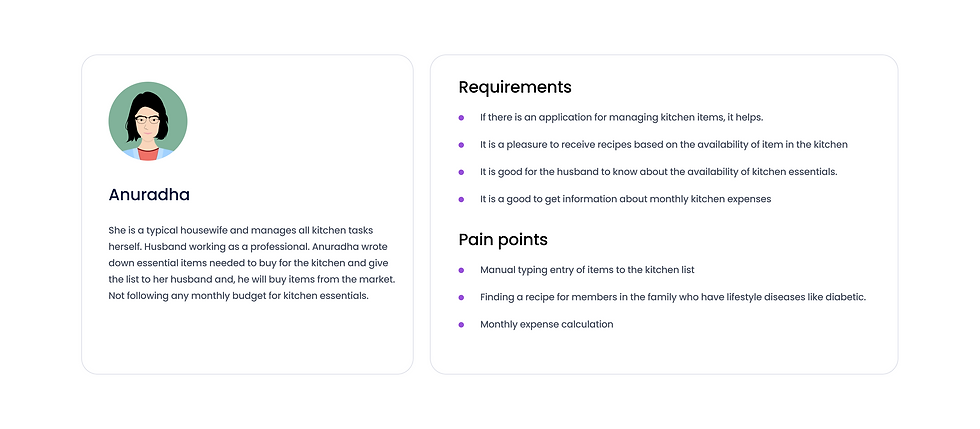
User personas
The persona is a fictional character created for representing a user type and common category behaviors and insights.
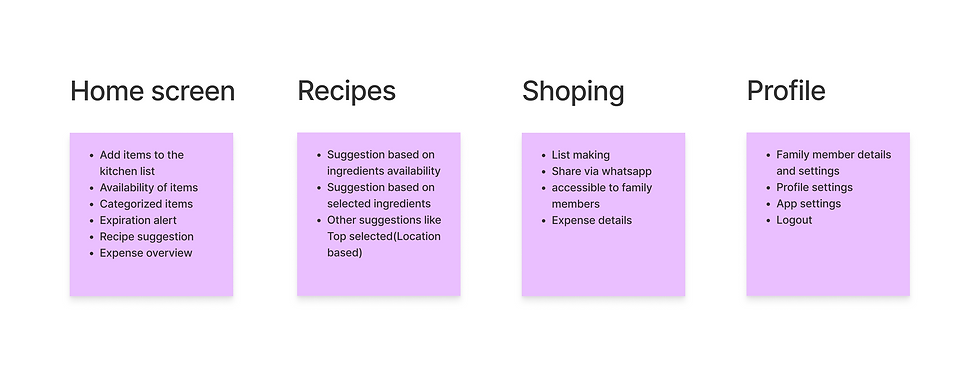
Keywording
After deep brainstorming, the collected data will be organized into relevant groups.
3. Ideate
User flow
I create user flows to see what flow users will go through to reach their goals, also I want to make sure that the flow is effective and efficient to achieve goals quickly. https://bit.ly/33Db9RG

Wireframing
With the user, the flow mapped out, and then, I proceeded to sketch wireframes. Several iterations of each screen to ensure that the elements that made it to the digital wireframes effectively addressed the user needs and goals. https://bit.ly/3Aa7Qhm


Conclusion
From all the processes that have been carried out until the final process, it can be concluded that the users can easily understand the user flows, the user feels that the experience of using the application can be easier than the user experience of the applications those I had to select for analysis. The information presented in the redesign also helps the user to solve the problem quickly and also, the information is valid and useful. So that it does not require the user to overthink.
Thanks for reading my case study! If you can provide criticism or suggestions about the case study, I will be very grateful.


